Wednesday, December 3, 2014

Configure HP Quality Center for Streamed XenDesktop 7.6

HP Quality Center is web based tool used by tester and developer (Don’t ask me more detail beyond this : ) )

image

While working with HP QC we must know it requires:

  • Requirements for QC to work is to have MS office 32 bit for now in base image, early next year TCOE/HP will update UFT after that we will be able to   use MS office 64 bit.
  •   HP QC will work only in IE 32 bit version
  • HP Quality Center download 280 MB of plugin and store under c:\users\APPDATA\LOCAL\HP

Now with above requirement if we are planning to deploy desktop class OS then you have multiple choice to choose from Flexcast model

image

Challenge : We have tried using UPM to synch around c:\users\APPDATA\LOCAL\HP but couldn’t  succeeded. So we tried PVD (Personal vDisk ) route but PVD does require minimum space and spending space just for 280MB file is waste of valuable storage space.

Solution: How about using Streamed static non persistent desktop. Once users logged in, desktop will be assigned to the users at the same time image can be streamed. We need to find out the way to redirect  APPDATA\LOCAL\HP . Remember this is not straight forward and that’s why we are discussing here.

User profile SID  sits in HKLM\Software\Microsoft\WindowsNT\Currentversion\ProfileList which is non-persistent since the C:\ drive is streamed in  read-only mode.

So first redirect : HKCU\Software\Microsoft\Windows\CurrentVersion\Explorer\Shell Folders

 image

HKCU\Software\Microsoft\Windows\CurrentVersion\Explorer\User Shell Folders

image

When running Quality Center  for the first time it loads ALM-Platform-Loader.msi, a copy and associated files are copied to AppData\Local\Microsoft\Windows\Temprorary Internet Files\Content.IE5 folder.  Because of the read-only nature of the images and the UPM is not synchronizing AppData\Local contents when a VM is rebooted and re-logged. It also creates a folder under AppData\Local\Temp called TD_80; this folder disappear when a user reboots the VM.

To fix this we have to do two more redirection 

HKCU\Software\Microsoft\Windows\CurrentVersion\Explorer\Shell Folders
image

CACHE

image

Tem and Temp here to be redirected:

image

All the registry changes can be pushed via GPO along with UPM .

Credit : Thanks for sharing this inputs my friend, you know whom I mean Smile

Tuesday, December 2, 2014

Load balancing users across datacenter using XenDesktop 7.6

We get requirement quite often to load balance users across datacenter and provide DR with XenDesktop. There are tons of article which will help you to design so. But what we are discussing here is load balancing users within delivery group.

Requirement : Load balance users delivery group across datacenter. If there are 100 users in a particular use case then 50 users should be directed to datacenter A and 50 users should be redirected to datacenter B.

Challenge: It would have been easy if we had to just load balance users. We could have used GSLB and distribute users in round robin fashion. But when it comes to delivery group this has its own challenge. To achieve this we do require single farm architecture. To build single farm architecture we do require SQL availability across the location. Challenge is with the amount of require bandwidth and latency within India. In general latency across two cities in India is around 60ms.

Gotchas: Profiles availability across datacenter. Microsoft does not support profile replication. So if we need profiles with the users then we must use two separate store at each datacenter.

How to achieve this: To start with I will put some drawing to make it simple.
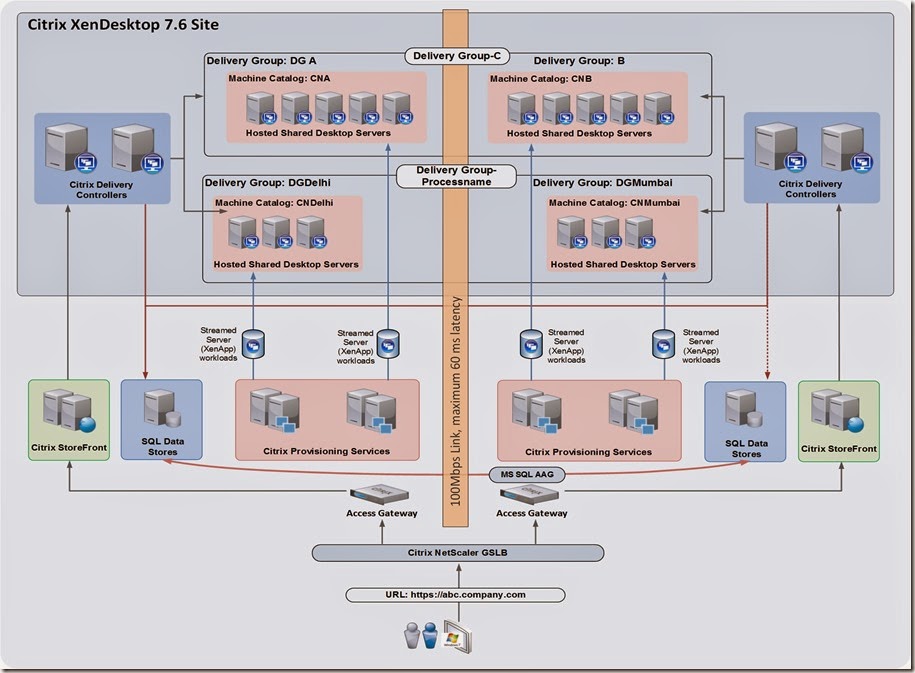
SutherLand Design Document - ForBlog

Component configuration:

Two Delivery Controller at both datacenter: Total of four  Delivery Controller will be part of the single XenApp/XenDesktop Site. But here is the catch, VMS at respective DC will be pointing to respective Delivery Controller . So VMS will be register with only with respective site delivery controller.

Two StoreFront at both the datacenter: Two storefront will be in cluster at each of the datacenter. NetScaler will be used to load balance each of the storefront farm across datacenter.

Separate PVS farm at each of the datacenter: Each of the farm will be streaming VM’s in their respective datacenter.

Now coming to the important part is SQL setup. There are many ways we can setup SQL for database replication and I am not going to explain those. You can refer to article like this to get that configure. What I will explain you is how we did the setup in our environment. Two  SQL has been setup with Multi Subnet fail over cluster and something similar explained here
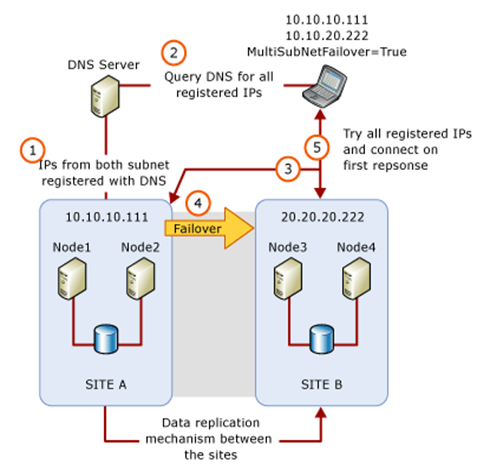
image

In our case we have one node at each of the site. WFC has been setup with the following roles

image
Under the server name there are two IP’s and this is used for Availability Group Listeners under SQL
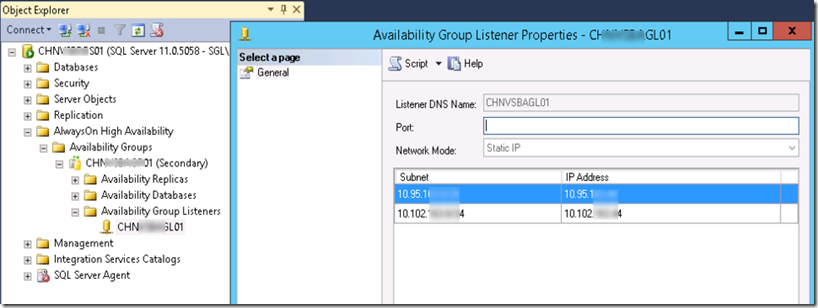
image

WFC resource property is important to understand for failover .
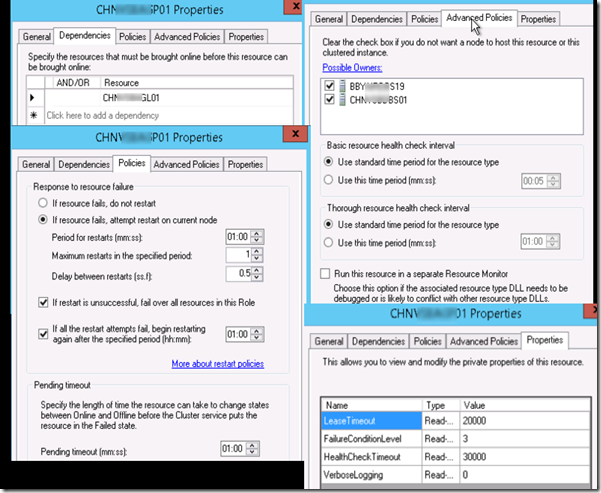
image 

This is how listener group looks like

image

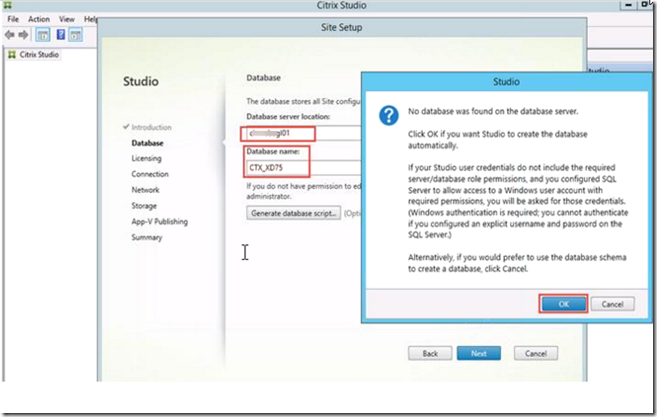
We are replicating three database a)Site b)Logging c)Monitoring using AlwaysOn High Availability. During site creation we pointed it to listener database and allow Studio to create database. Once database were setup, It was then moved to Always ON group.
 image

Then we separated all the database and moved separately. Now time for testing? No before we start testing we have to follow few more steps to ensure Delivery Controller is MultiSubnet aware and logins are replicated. To do so I followed Citrix blog and download the script listed here. Now its time for powershell magic. Open powershell from desktop studio and check if you have all the scripts. We need to run Change_XD_TO_MultiSubnetFailover.ps1

image 

Once script executed then it will be upload

image

Post this when we run get-brokerDBConnection it will showing multisubnetfailover=true.image

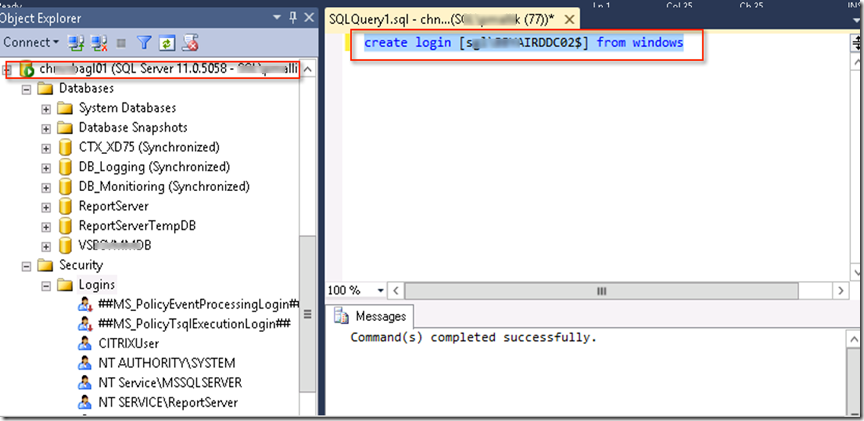
Now make sure logins for all the DDC is created on replica database .
image

DDC is ready for fail over testing. Now we need to create delivery group for  datacenter A and map catalog corresponding catalog. Separate delivery group for datacenter B  mapped to catalog for respective dc.

Now we need to publish desktop  to this both deliver group.

Add-BrokerApplication -Name "Publised App Name" -DesktopGroup "Delivery Group A"

Add-BrokerApplication -Name "Publised App Name" -DesktopGroup "Delivery Group B"

So what will be the end result: Users will hit GSLB which will deploy users in round robin fashion across datacenter. Users will  land on one the LB Store Front server and will get access to application. Users will be load balanced in round robin fashion but will land on same delivery group. Delivery group which doesn’t have priority (Fail over priority can be defined for delivery group) defined. Delivery group is going to distribute users across the VM . Incase of one of datacenter goes down SQL connection will failover to other site. This will have to wait till DNS update happen and listner group IP is changed to other site. Then we will be using connection leasing feature of XD 7.6 which is similar to LHC of XenApp 7.6 .

Drop a note incase you have question.

Saturday, October 18, 2014

Prepopulating Citrix Receiver within ICA session.

We get the requirement quite   often that once users logged into virtual desktop application should launch via seamlessly. Here seamlessly have many meaning  and it varies from customer to customer. For example one customer would like the application to be present as a shortcut in the start menu and when users click the application it must do single sign on.  There are various way to achieve this. Once can import receiver ADM template using gpedit.msc

To prepopulate the receiver with the URL

image

To prepopulate url , one can do it via adm template or via Citrix HDX policy . To do it via adm template, import it into local policy and then perform following settings

image]

Once storefront url is selected value must be entered in following format “

SalesStore;https://sales.mycompany.com/Citix/Store/discovery;On;Store for Sales staff” and even one doesn’t want to wish to have it. So once this is done it will prepopulate the URL.

Once url is prepopulated, SSO has to be done. To do the so , we must choose “local user name and password” and then choose Enable pass-through authentication.

image

This will allow single sign on and allow users to launch application seamlessly.

Tuesday, October 14, 2014

Failed to add a Failover Cluster Node because “SQL Server Agent” account name empty

I came across interesting issue on two occasion when I tried adding second node to the SQL 2012 cluster node. After it detecting the second server detail, account name for “SQL Server Agent”  is blank. After we typed password this still fail with error message “There are validation error on this page”

image

We tried rebooting boxes but that didn’t help. Finally to fix this we need to create

1. SQL Server agent 2. Add the same agent as fail over cluster resources.

You can do this steps on any of the fail over cluster node. Use following PS editor to run the command

image

$ClusterName = "YourClusterName"
$FciClusterGroupName = "SQL Server (MSSQLSERVER)" # may need to modify to reflect your environment

Add-ClusterResourceType -Name "SQL Server Agent" -Dll "sqagtres.dll" 

Output of command will be like this

image

Once this is done,select role –>Add Resource –> More Resources –>

image

More Resources –> SQL Server Agent

image

Select “New SQL Server Agent” and --->properties –>Dependencies select resource as “SQL Server”

image

Now select properties tab and type  InstanceName = <Name of the SQL server Instance name> VirtualServerName =<Name of the SQLCluster>

image

Now the “New SQL Server agent”  will start

image

Make sure the registry on primary server is set to 1

image

After above steps when setup is run again , it was able to see SQL Server Agent users name.

image

Yeah I am also a SQL expert Smile

Source here

Thursday, May 22, 2014

Citrix Profile and folder redirection without Microsoft GPO

Sometimes you have a situation where profile and folder redirection can not be done via Windows GPMC. Citrix provide you an option to do so via HDX policy. Citrix have inbuild policy which can used to achieve this. This way we may not require help from AD team and can be managed at our own. I am not going to explain  what all we can apply as part of UPM because everything is available here , here and here.  Profile and redirected folder path must be different .

1. To get this first make sure path is define in this way for each of the folder redirection highlighted in red

SNAGHTML1043896f

Along with each of the folder redirection make sure that “Redirect settings for <folder name>” is selected to “Redirect to the following UNC path”.

2. Make sure policy is applied to the users group

SNAGHTML10464b76

3. For UPM alone path should be set to \\path to folder\#SAMaccountname#or %username% also make sure following should be defined

SNAGHTML1049c92d

For rest of the settings and best practices please follow the above mention 3 link .

Gud luck for not using Microsoft GPO :)